

EMERGENCE
The Classic Maya, a mysterious civilization in the Yucatán peninsula that abandoned its elaborate jungle cities 1,000 years ago, devised a system of timekeeping that was extraordinarily intricate and accurate. It tracks the movements of planets and stars, denoting eclipse cycles and perhaps larger galactic harmonics as well. Although my book 2012: The Return of Quetzalcoatl explores indigenous prophecies and the potential for a shift of planetary consciousness in our time, I never pretend to be an expert on the Mayan Calendar. My understanding is based on secondary sources, including the works of visionary theorists, mainstream anthropologists, and archaeologists.
Among the various cycles they studied, the Classic Maya followed a non-repeating Long Count calendar of slightly less than 5,200 years, beginning in 3112 BCE and culminating in a “galactic alignment” that was encoded in the friezes and architecture of their temple-complexes. While the Long Count was not passed down to the living Maya of today, it seems that it held a major role in Classic Maya cosmology. According to anthropologist Michael Coe, the Aztecs and Maya shared a cyclical vision in which humanity and the earth were periodically created, destroyed, and recreated anew.
In his book The Maya, Coe writes, “The Aztecs, for instance, thought that the universe had passed through four such ages, and that we were now in the fifth, to be destroyed by earthquakes. The Maya thought along the same lines, in terms of eras of great length, like the Hindu kalpas. There is a suggestion that each of these measured 13 baktuns, or something less than 5,200 years, and that Armageddon would overtake the degenerate peoples of the world and all creation on the final day of the thirteenth; the Great Cycle would then begin again.”
During the last decades, scholarly consensus has placed the end of the thirteenth baktun and conclusion of the Long Count perilously close to our own present tense: December 21, 2012. On that date, according to the studies of John Major Jenkins, the winter solstice sun will rise in the dark rift at the center of the Milky Way and eclipse the galactic center. For reasons that are still somewhat obscure, the Classic Maya appear to have linked this astronomical event, which occurs once every 26,000 years, with a larger transmutation of human consciousness and perhaps the Earth itself. When we look at the multidimensional planetary crises we face at this juncture, such as species extinction and climate change, it seems a numinous correspondence that the Maya pointed to this time as a crucial opportunity for transformation.
Exploring the meaning of a shift between world ages, visionary theorists such as Terence McKenna, José Argüelles, and Carl Johan Calleman have proposed a model in which our experience of time—or what McKenna called “the ingression of novelty into history” or new discoveries, unprecedented events, and creative and destructive breakthroughs—continues to accelerate until a threshold is reached, after which point we enter into a new realization of time, space, and being. We tend to forget that our model of history is, in itself, a historical construct. Before there was history, there were myths and dynasties. Therefore, it is possible that, in the future, we may find other ways to order and interpret our experience.
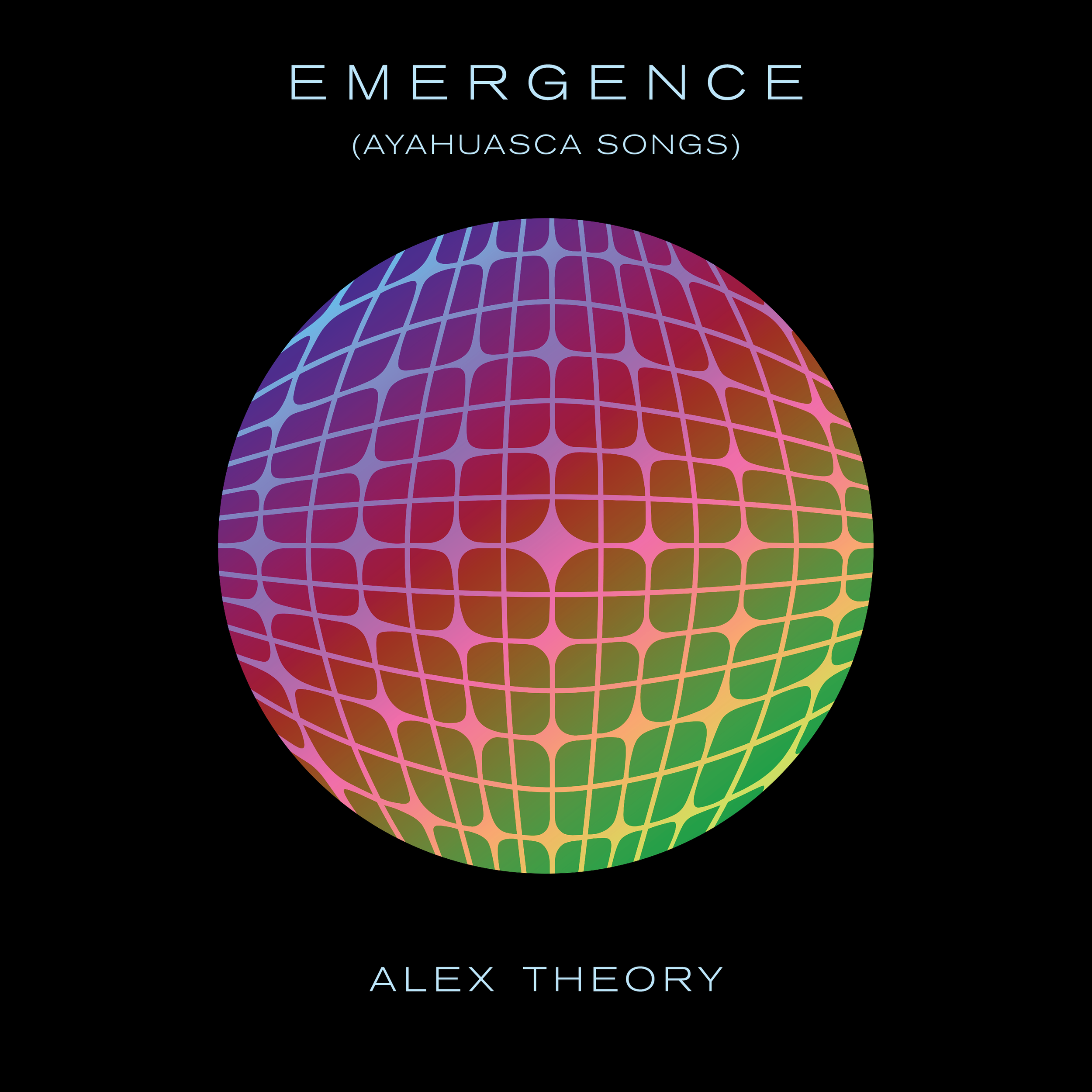
On Emergence 2012, Alex Theory offers an ambient interpretation of the baktun cycle, a lush and architectonic soundscape that takes listeners on a journey through an archaic underworld of jungle sounds and shamanic shivers. His approach incorporates the underlying mathematics of the Tzolkin, the 13-by-20 matrix that creates the 260-sacred-day count of the Maya: the 13 songs that make up Emergence 2012 increase by four beats per minute (bpm), eventually reaching 130 bpm, half of the magic number 260. The Maya believed the 13-by-20 Tzolkin matrix was built into the structure of our universe and even reflected in our bodies—each of us possesses 20 fingers and toes and 13 major articulations of our joints. In addition, 260 days is the average gestation period of a human fetus, and our solar system is roughly 26,000 light years away from the black hole at the center of this galaxy.
While many people fear the potential cataclysmic effects of a planetary shift as we approach 2012, Theory’s tracks offer an alternative viewpoint. The songs suggest the transitions between events, like the pause between each of our breaths, which gives us the perpetual opportunity to return to our center. Perhaps these pauses and subtle transitions are the true events within human consciousness, while the external roster of wars and natural disasters are like drumbeats and percussive exclamations, marking a secret evolution in our awareness.
The Classic Mayan vision of the nature of reality was radically different from our modern perspective. The various intermeshing cycles of the Mayan Calendar create a harmonic loom of synchronicities and correspondences, revealing space-time to be something like a musical composition or symphony. As we go deeper into this time of transformation, it appears as if the various contradictions of our human world are deepening. As more and more possibilities open up, the paradoxes that bedevil us are not being resolved; instead they are becoming evermore confounding and powerful. If our logic fails us, we may find that a harmonic or musical model of the universe—structured as themes seeking resolution, developing through counterpoint—is more satisfying to our deeper instincts than any reductive explanatory grid.
Where are we all heading? I don’t presume to have a clue. Emergence 2012 laces the chants and whirring rattles of ayahuasca shamans from the Amazon jungle into its sound collage. By entering trance, ayahuasca shamans supersede logical contradictions by immersing themselves in vision possibility, thus recovering the imaginal “perhapsness” that seems to reside at the core of being itself. As our financial institutions, support structures, climate, and ecosystems disintegrate around us, we may find that the path leading beyond the collapse is through the portal of our creative imagination, through which we might call new worlds into being, if only we remember how.